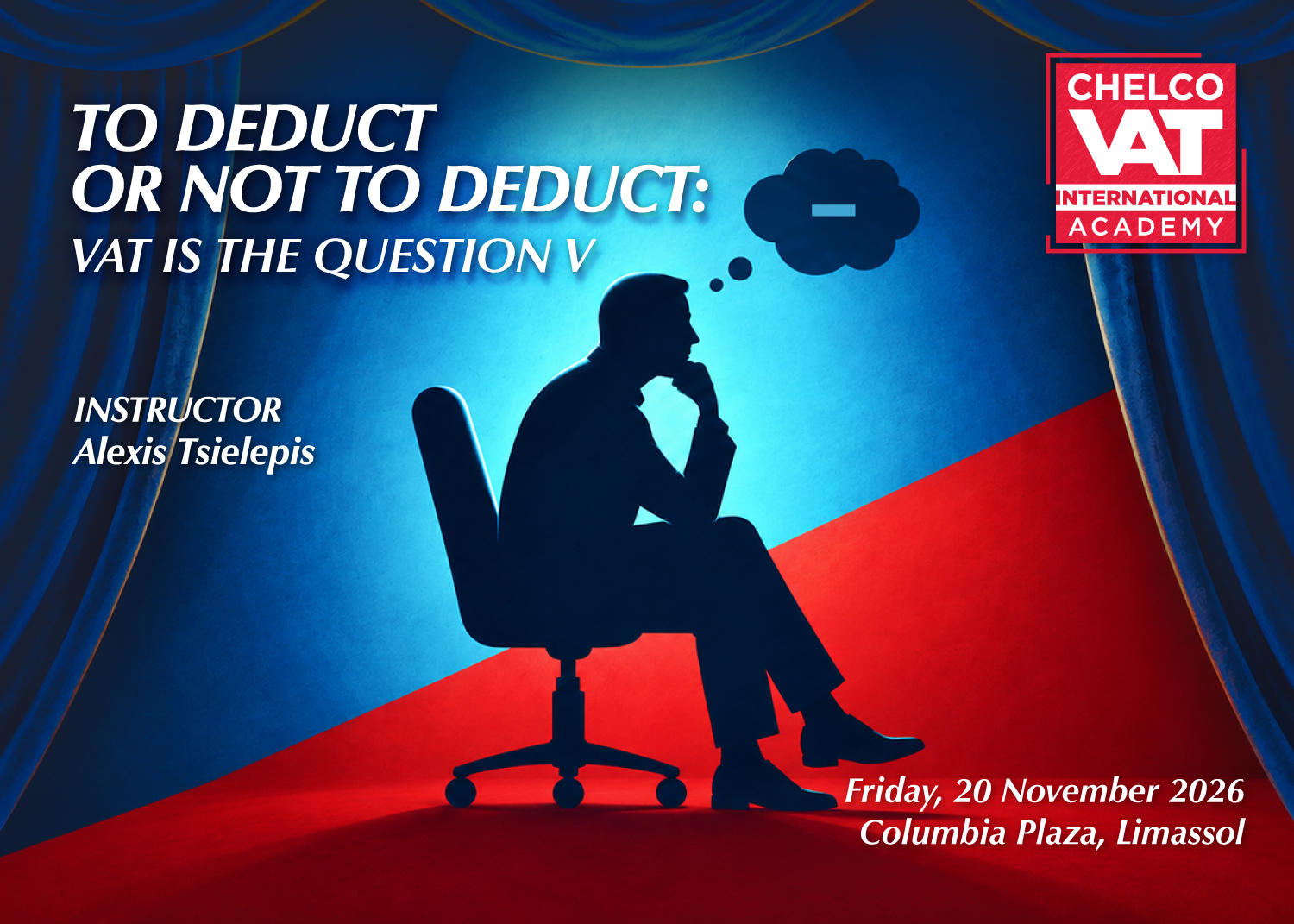
To Deduct or Not to Deduct: Vat Is The Question V
Yes, the fifth instalment. Some franchises know when to stop. This isn’t one of them.
We’ve run this seminar four times before under the same title, and we’re not changing it now. The title is too good, and frankly Shakespeare wouldn’t have it any other way. Like any decent sequel, though, the plot is new, and we will look at the topic through fresh eyes.
Why it still matters
The Right to Deduct is the single most important part of the VAT system. It is what makes VAT a tax on consumption and not a cost to business. The Court of Justice has said again and again that it is a fundamental right of the taxable person and, in principle, cannot be limited.
In practice, “in principle” is where things get interesting. Businesses now carry out so many different kinds of transactions that input VAT Deductions are easy to get wrong. When that happens, the tax authorities tend to notice, and the disagreement can be expensive. A solid grasp of how deductions work is no longer optional. It is cheaper than the alternative.
What we’ll do
We’ll start from first principles and build up the reasoning: why deductions exist, how they should work, and our 3-step approach to getting them right. By the end of the morning seminar you should have a clear, joined-up picture of when a deduction is allowed, with particular focus on the Cyprus VAT legislation, and of how to calculate it in practice.
We will cover:
- The key provisions of the Cyprus VAT Law and the EU VAT Directive on the right to deduct
- Economic and non-economic activities: knowing which is which, and why it matters
- Our 3-step approach to deductions
- The “direct and immediate link” test between a cost, its input VAT and an activity
- Non-economic activities: the logic behind apportioning input VAT, the pre-pro-rata method, and other methods that may apply
- Exempt activities: the pro-rata method for common costs, and when a different method can be used
- Court of Justice judgments that illustrate each point, because European judges say it better than we do
Who should attend
Anyone who deals with VAT and would rather not learn about deductions from a VAT assessment: Accountants at every level, chief accountants, CFOs, financial controllers, VAT advisors, auditors, tax lawyers and tax advisors.
To deduct or not to deduct? Join us on 20 November and leave knowing the answer.
Agenda
Registration & Coffee
Welcome Address
Alexis Tsielepis, Instructor
- Starting point
- Non-economic activity
- Understanding Input VAT
- Direct & immediate link
- Deductions STEP 1 (direct allocation)
- Deductions STEP 2 (pre pro-rata)
Coffee Break
- Deductions Step 3 (pro-rata, de-minimis rule)
- Adjustment to initial deductions (supplies acquired, capital goods)
- Deduction with no output transactions
- Formalities
- Specifics of Cyprus law
- Homework: Apportionment example
Discussion and Questions
End of Seminar
Instructor

Alexis Tsielepis, BSc, FCA
Managing Director
Chelco VAT Ltd
[email protected]
Alexis is widely considered as the foremost expert on VAT in Cyprus. With 20 years of experience in VAT strategic consulting, he advises businesses on international VAT matters and lectures at local and international VAT conferences.
Alexis possesses extensive vocational and educational experience in European VAT and a detailed comprehension of EU VAT matters and decisions of the European Court of Justice (ECJ). He has served on various committees charged with tax matters and his work includes liaising with the Cyprus tax authorities and government on policymaking.
He has written a number of tax syllabuses, chapters and articles on matters pertaining to Cyprus and EU VAT. He is the author of the book “An in-depth analysis of the Fixed Establishment concept and a comparison with the Permanent Establishment concept”.
Alexis is a Fellow of the Institute of Chartered Accountants in England and Wales (ICAEW) and holds the Expert in European Value Added Tax Degree, which he earned with the highest grade ever awarded in the history of the coveted diploma. He is the co-founder and Vice-Chairman of the Cyprus VAT Association (CYVA) and a Partner and Director of the VAT Forum in Belgium.
On 1 October 2025, Alexis was appointed by the European Commission (EC) to the prestigious VAT Expert Group (VEG) for a three-year mandate. A total of 36 VAT experts assist and advise the EC on VAT matters, including the preparation of new legislative acts and other policy initiatives, on practical VAT administrative issues and good practices, as well as on the practical implementation of VAT legislation.
Alexis is sharing his knowledge on VAT in a series of seminars and workshops organised by the Chelco VAT International Academy, covering an array of VAT-dedicated topics, with the crown jewel being the Diploma in VAT Excellence (DiVE), a 10-month course covering EU and Cyprus VAT law in a depth never before seen in Cyprus.
Alexis is a Certified Vocational Trainer with the Human Resources Development Authority of Cyprus (ANAD).
Who Should Attend?
-
Accountants
-
VAT Department Officers
-
Chief Accountants
-
CFOs/Financial Controllers
-
VAT Consultants
-
Tax Consultants
-
Tax Accountants
-
Tax Lawyers
When, Where & How Much?
Limassol
Friday, 20 November 2026, Columbia Plaza Venue Centre
9:00am – 1:30pm (Registration at 8.30am)
4 CPD Units (certificates of attendance will be provided)
€175 + VAT
Group Discount (for 3 persons or more): 15%
Free for current students of the Diploma in VAT Excellence (DiVE).
English