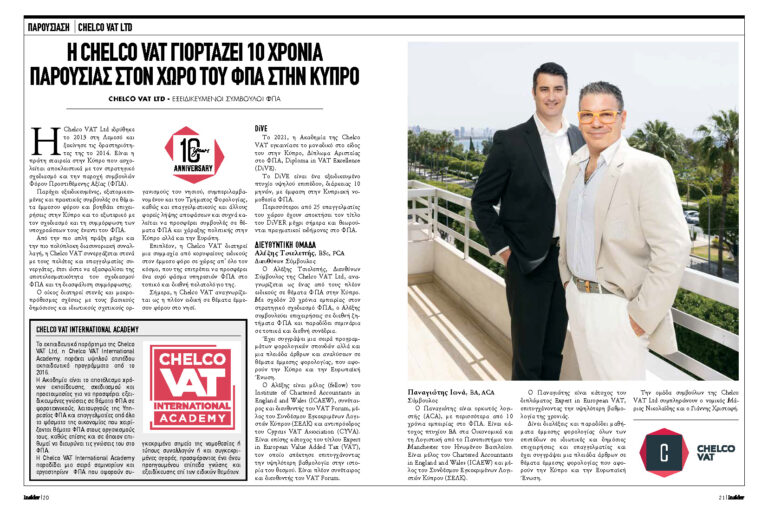

By Alexis Tsielepis
Managing Director, Chelco VAT Ltd
The Sixth VAT Directive, adopted on 17 May 1977, required Member States to implement its provisions by 1 January 1978. Within it, Article 26 introduced a bespoke VAT framework for travel agents and tour operators—the Tour Operators Margin Scheme (TOMS).
Its guiding principle was simple: simplification.
Nearly five decades on, the principle remains intact, while the industry it governs has profoundly evolved.
The travel sector has undergone a profound transformation. Globalisation, enhanced health and safety standards, rapid technological advancement, and increased consumer purchasing power have made travel more accessible, diversified, and immediate. Investment from both public and private sectors has elevated the overall travel experience, while SMEs have driven the expansion of bespoke travel offerings. Meanwhile, the rise of digital platforms has fundamentally reshaped booking behaviour, with online travel experiencing exponential growth.
Against this backdrop, TOMS has struggled to keep pace.
Two persistent challenges have defined the debate. First, elements of the regime no longer deliver the intended simplification in a vastly evolved marketplace. Second, inconsistent application across tax administrations has created distortions, undermining fair competition.
While the Court of Justice of the European Union has provided interpretative guidance—sometimes helpful, sometimes contentious—the framework remains fragmented.
The European Commission has not been idle. A 2017 study identified significant shortcomings in the VAT treatment of TOMS, followed by further analysis in 2020 under the Commission’s Action Plan. Momentum, however, appeared to stall as attention shifted to VAT in the Digital Age (ViDA), adopted on 11 March 2025 and set for phased implementation through 2035.
Yet the question lingered: what comes next?
Recent developments suggest a decisive shift. A two-day joint workshop—bringing together the EU VAT Expert Group, Fiscalis, and the Commission—summoned 94 stakeholders across industry, tax administrations and advisory practices. Through structured discussions, participants revisited long-standing proposals to modernise VAT rules for the travel sector, including TOMS.
Although I cannot comment on details, consensus proved elusive.
Diverging commercial interests, policy priorities, and national positions ensured that alignment remained out of reach. Each stakeholder group—unsurprisingly—advocated from its own vantage point. Yet the absence of consensus should not be mistaken for lack of progress.
On the contrary, it signals something more important: movement.
The Commission’s role—deliberately restrained during discussions—suggests a shift from consultation to consolidation. The direction of travel is becoming clearer. A proposal for an amending directive is now expected before year-end.
Crucially, key reforms long advocated by the industry are firmly on the table. These include the potential introduction of a B2B option and the adoption of a global margin calculation—measures consistently highlighted in prior studies as essential to restoring both neutrality and simplicity. While the final shape of these reforms remains uncertain, their re-emergence in serious policy dialogue is significant.
This is not a straightforward reform exercise. It is a complex, politically sensitive undertaking involving competing interests, powerful lobby groups, and an ecosystem comprising tens of thousands of businesses and millions of jobs—all within an increasingly global competitive landscape.
The narrative that the Commission was procrastinating, now appears misplaced.
It was preparing.
And now, the pace has changed.
TOMS reform is no longer theoretical—it is imminent.